
Toxic cyanobacteria, commonly known as blue-green algae, pose a risk to global drinking water supplies. The most notorious threat are microcystins, which are potent liver toxins that have caused mass poisonings and chronic liver damage.
Cyanobacterial blooms are likely to increase due to climate change (warmer waters) and nutrient pollution, and many consumers and municipalities are turning to filtration as an important line of defense. But how effective are domestic and municipal water filters in removing microcystins?
What Are Microcystins?
Microcystins are a family of cyclic heptapeptides produced by certain cyanobacteria such as Microcystis, Anabaena, and Planktothrix. Over 50 variants have been identified, with microcystin-LR being the most toxic and widely studied (Lawton et al., 1998). These toxins inhibit protein phosphatases 1 and 2A in liver cells, leading to cell damage, tumor promotion, and even death in high doses.
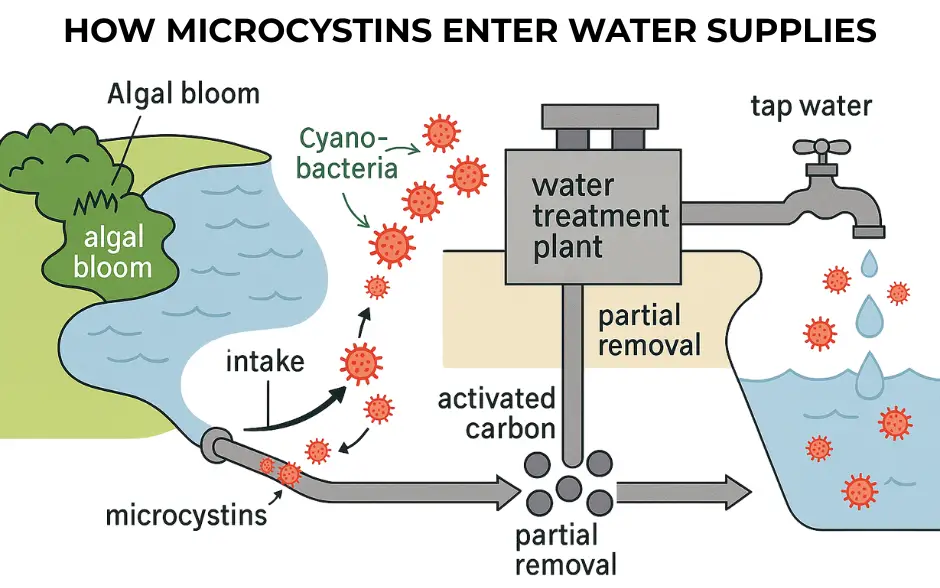
Microcystins enter drinking water primarily through the breakdown of cyanobacterial (blue-green algae) cells in freshwater sources such as lakes and reservoirs. When the cells die, either naturally or as a result of water treatment processes like chlorination or mechanical disruption, they release microcystins into the water. Because these toxins are dissolved and stable, they can persist through conventional treatment steps like coagulation and filtration, making them a serious risk in treated tap water if not properly addressed.
Risks to Human Health
The World Health Organization has set a provisional guideline of 1.0 µg/L for microcystin-LR in drinking water. However, studies suggest that chronic exposure to even lower concentrations may be harmful, especially due to their tumor-promoting effects (Hitzfeld et al., 2000).
One of the most infamous incidents linked to microcystin occurred in Caruaru, Brazil, where at least 60 dialysis patients died after being exposed to contaminated water that bypassed standard treatment and monitoring (Hitzfeld et al., 2000).
Conventional Water Treatment: Microcystin Removal
Coagulation, Sedimentation, and Filtration
Conventional methods such as coagulation, flocculation, sedimentation, and filtration are primarily effective at removing intact cyanobacterial cells, provided cell lysis (breakdown of the cell membrane, releasing the cell’s contents) is avoided. However, these techniques are largely ineffective at removing dissolved microcystins. Studies have shown that even after flocculation and filtration, only 60% of microcystin toxicity is typically removed (Hoeger et al., 2005).
Advanced Municipal Treatments: Effectiveness
Ozonation
Ozone is highly effective in oxidizing microcystins under the right conditions. In one Swiss treatment plant, pre- and intermediate ozonation combined with activated carbon significantly reduced toxin levels, even during blooms of Planktothrix rubescens (Hoeger et al., 2005). However, treatment effectiveness depends on ozone concentration, contact time, and water quality parameters like pH and organic load.
Activated Carbon Filtration
Both powdered activated carbon (PAC) and granular activated carbon (GAC) are effective for removing microcystins, although performance varies by toxin variant, carbon type, and dosage. PAC often requires dosing rates of 20–200 mg/L for effective microcystin-LR removal. GAC, while useful, shows reduced adsorption capacity over time, especially in the presence of biofilm or dissolved organic carbon (which is typical when carbon filters get used for some time) (Newcombe & Nicholson, 2004).
Notably, biofilm formation in carbon filters can impede toxin adsorption, and there’s limited evidence that microcystins are biodegraded by such biofilms (Hitzfeld et al., 2000).
What About Domestic Water Filters?
A key study by Lawton et al. (1998) examined the efficacy of three brands of household pitcher-style water filters. These filters, equipped with ion exchange resins and activated carbon, removed between 35–60% of microcystin-LR. However, no filter achieved complete removal in a single pass, and filter performance deteriorated with use, especially after reaching half their rated capacity.
Importantly, the morphology of cyanobacterial cells impacted filtration. Filamentous cells were removed more efficiently (~60%) than unicellular forms (~10%). Since lysed cells release dissolved toxins, filters that remove only cells but not toxins offer limited protection.
The study concluded that repeated filtration passes or improved designs would be necessary to make these filters a viable safety measure during bloom events.
Reverse Osmosis (RO): Microcystin Removal
Reverse osmosis membranes with high rejection rates can physically remove microcystins from water. However, their efficacy is sensitive to membrane pore size and integrity. RO is most effective when used after pre-treatment steps that remove particulates and reduce membrane fouling (Dixon et al., 2011).
So, RO systems with pre-filters and good activated carbon filers will be more effective at removing microcystins.
Nanofiltration, a similar technology, has shown strong performance in removing low-molecular-weight cyanotoxins from pretreated waters, especially when paired with activated carbon.
Can UV or Boiling Remove Microcystins?
Natural sunlight has limited effect on microcystins, which are highly stable in ambient light. However, UV-C irradiation (e.g., 254 nm) can degrade microcystin-LR and microcystin-RR with short half-lives under laboratory conditions (Hitzfeld et al., 2000).
TiO₂-based photocatalysis has shown promise but is not widely deployed in municipal systems due to cost and scalability concerns.
Boiling water does NOT reliably destroy microcystins and may in fact concentrate them if evaporation occurs. Therefore, it is not recommended as a removal strategy.
Key Limitations in Treatment
Several studies stress that monitoring and response speed are critical limitations. Conventional plants may not detect toxins until after treated water has reached consumers (Hoeger et al., 2005). In addition, filters saturated with natural organic matter lose efficacy for toxin adsorption, and backwashing is not always effective in removing accumulated biomass.
Summary of Filtration Effectiveness
| Treatment Method | Effectiveness on Microcystins | Notes |
| Coagulation + Filtration | Limited (<60%) | Removes cells, not dissolved toxins |
| PAC (Powdered Activated Carbon) | High (>90%) with correct dosing | Dosage-sensitive; effective at 20–200 mg/L |
| GAC (Granular Activated Carbon) | Moderate, declines over time | Biofilm impairs performance |
| Reverse Osmosis | High | Pre-treatment recommended |
| Nanofiltration | High | Effective in treated water |
| UV (254 nm) | Moderate | Laboratory efficacy proven |
| Domestic Pitcher Filters | Low to moderate (up to 60%) | Multiple passes needed |
So, filters can remove microcystins, but with limitations.
Some municipal filtration systems, when using multi-barrier approaches (coagulation, ozonation, activated carbon, and UV), can achieve effective microcystin removal. Domestic filters, particularly pitcher-style units, offer partial protection but should not be relied upon during active blooms unless tested for this specific application.
I reviewing the official NSF certification listings, and the only brand currently certified for microcystin reduction under NSF/ANSI Standard 53 was eSpring water filters by Amway. I’m definitely NOT affiliated with Amway at all, but some of their products that were tested for microcystin removal include:
- eSpring 122940 series (multiple international variants)
- eSpring 122941
- seriesModel 100185 and
- 100186 variants (countertop or plumbed-in)
- Replacement Filter: WTI1167X
However, I doubt that any generic water filters that fit these products would be tested to the same level of NSF certification – so, be careful.
Reverse osmosis and activated carbon systems remain the most effective consumer-level options, but require proper maintenance and awareness of their capacity limits.
Ultimately, while filtration is a crucial barrier, proactive monitoring, source water protection, and public advisories are essential to protect consumers from cyanotoxins like microcystins.
References:
Dixon, M.B., Falconet, C., Ho, L., Chow, C.W., O’Neill, B.K. and Newcombe, G., 2011. Removal of cyanobacterial metabolites by nanofiltration from two treated waters. Journal of hazardous materials, 188(1-3), pp.288-295. <https://doi.org/10.1016/j.jhazmat.2011.01.111>
Hitzfeld, B.C., Höger, S.J. and Dietrich, D.R., 2000. Cyanobacterial toxins: removal during drinking water treatment, and human risk assessment. Environmental health perspectives, 108(suppl 1), pp.113-122. <https://doi.org/10.1289/ehp.00108s111>
Hoeger, S.J., Hitzfeld, B.C. and Dietrich, D.R., 2005. Occurrence and elimination of cyanobacterial toxins in drinking water treatment plants. Toxicology and applied pharmacology, 203(3), pp.231-242. <https://doi.org/10.1016/j.taap.2004.04.015>
Lawton, L.A., Cornish, B.J. and MacDonald, A.W., 1998. Removal of cyanobacterial toxins (microcystins) and cyanobacterial cells from drinking water using domestic water filters. Water Research, 32(3), pp.633-638. <https://doi.org/10.1016/S0043-1354(97)00267-4>
Newcombe, G. and Nicholson, B., 2004. Water treatment options for dissolved cyanotoxins. Journal of Water Supply: Research and Technology—AQUA, 53(4), pp.227-239. <https://doi.org/10.2166/aqua.2004.0019>