
New research has raised serious concerns about the safety of drinking water in the United States.
The study points to home water filtration systems as a practical way to ensure consistently high-quality drinking water.
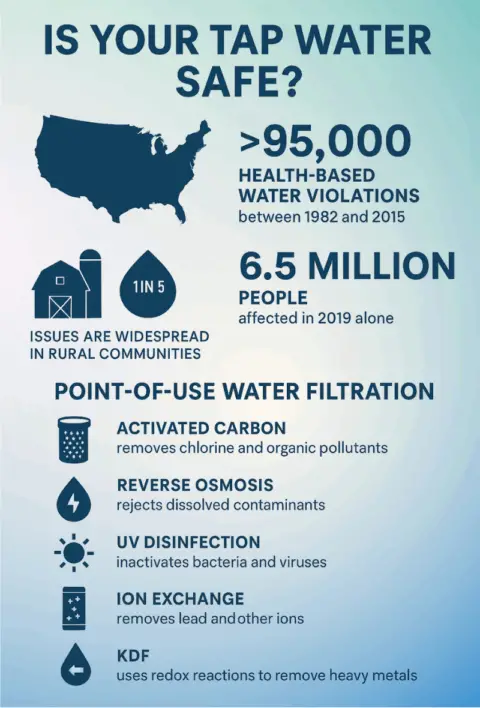
According to a 2021 review published in Nature Partner Journals (NPJ) Clean Water, more than 6.5 million people were affected by health-based violations of U.S. drinking water standards in just one year.
These violations were most common in rural areas where aging infrastructure, limited funding, and reduced access to technical expertise make it difficult for small systems to stay compliant with federal regulations.
The study, led by researchers at UCLA, found that between 1982 and 2015, more than 95,000 health-related violations were recorded across nearly 18,000 community water systems. At times, as many as 45 million people were impacted in a single year.
Some of the highest rates of repeated violations were concentrated in rural counties in Texas, Oklahoma, and Idaho.
In Oklahoma, 43% of community water systems had multiple years of repeat violations.
About one-third of systems in Nebraska and Idaho failed to meet health-based standards in consecutive years.
These issues are often linked to aging treatment plants, underfunded local utilities, and difficulties attracting trained personnel to manage system operations.
Private wells, which serve around 43 million Americans, are also a major concern. These wells are not regulated by the Safe Drinking Water Act, and the study noted that roughly 1 in 5 domestic wells contained contaminants above safe health thresholds. Arsenic, lead, nitrate, and microbial contamination were frequently detected, posing risks that may go unnoticed for years without proper testing.
The study emphasized the value of using point-of-use (POU) water filtration systems in the home. Most of these devises are installed on the water supply lines just before the point of consumption, or directly at the tap.
There are a wide range of POU technologies including activated carbon, reverse osmosis, ion exchange, and ultraviolet light, which can effectively remove a broad spectrum of contaminants.
While the paper does not prescribe one-size-fits-all solutions, it highlights how POU systems can be selected to address the specific water quality issues a household may face. For example:
- Activated carbon filters that remove chlorine, organic pollutants, and disinfection byproducts.
- Reverse osmosis membranes which reject nearly all dissolved contaminants, including heavy metals and PFAS.
- UV disinfection units that inactivate bacteria and viruses without introducing harmful byproducts.
- Ion exchange resins that effectively remove lead and other dissolved ions.
- KDF filters that use redox reactions to remove heavy metals and inhibit microbial growth.
Some newer filter systems offer “smart” features such as mobile app integration, filter-change alerts, or built-in sensors to monitor water quality.
But the researchers behind the study caution that “smart” features does not always mean better contaminant removal. Basically, just because it connects to your phone doesn’t make the filter more powerful. Look for certifications and test results before you buy.
Importantly, the review also points out that federal regulation of new contaminants can take years or even decades and POU filtration may be one of the most accessible and immediate ways for individuals to protect themselves and their families from unsafe water.
Many households already use POU filtration systems, but the researchers encourage broader adoption.
They also call for more innovation in filter design, particularly those targeting contaminants of emerging concern like PFAS.
Journal source:
Wu, J., Cao, M., Tong, D., Finkelstein, Z. and Hoek, E.M., 2021. A critical review of point-of-use drinking water treatment in the United States. NPJ Clean Water, 4(1), p.40. <https://doi.org/10.1038/s41545-021-00128-z>