
Recently, a friend messaged me: “If PFAS are in my water, am I absorbing them every time I shower?” With all the news about “forever chemicals,” it’s a fair fear, and a lot more common than you might think.
Here’s the real answer: PFAS barely absorb through the skin. Even in contaminated water, your skin does a surprisingly good job of keeping them out when you’re showering or bathing.
Still, when it comes to chemicals that build up in your body and don’t go away, it’s smart to dig deeper and know where the real risks actually are.
PFAS Exposure Pathways
PFAS are a huge family of man-made chemicals that have been used since the 1940s in things like waterproof jackets, stain-resistant carpets, non-stick cookware, and firefighting foam. They’re prized for resisting water, grease, and stains, but that same resistance means they linger in our environment (and inside us) for years.
Studies have shown PFAS can enter our bodies through drinking water, food, and inhalation. And once they’re in, they tend to stay there. That’s why it’s so important to understand exposure pathways, and why skin exposure, even if it sounds scary, isn’t the biggest worry.
Skin Exposure
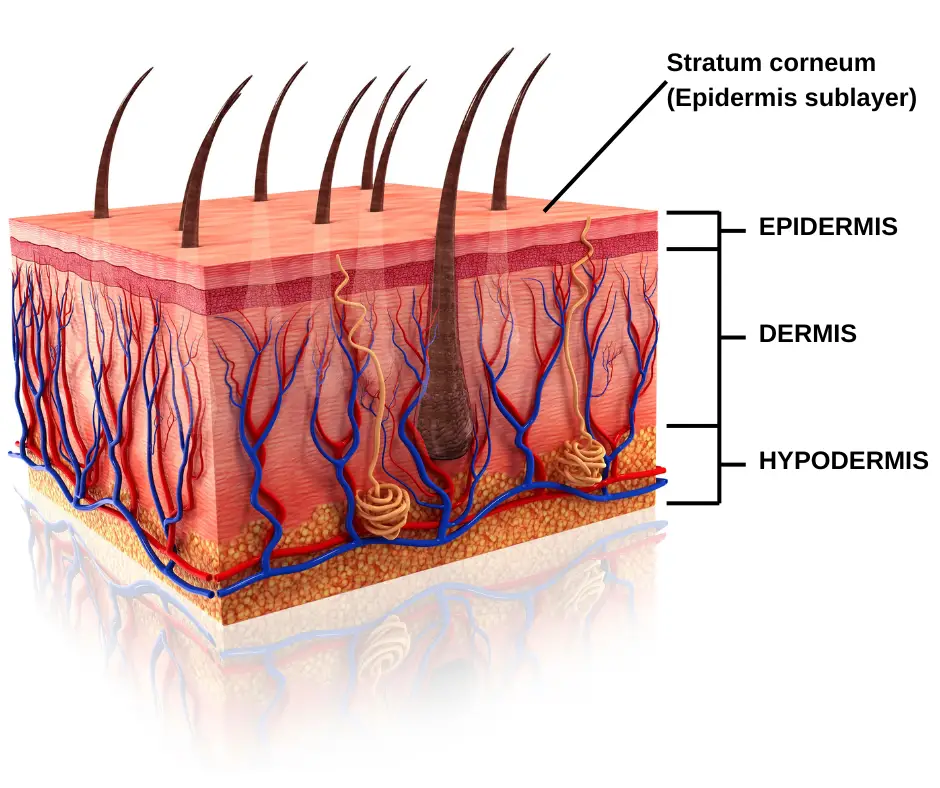
The skin has three main layers:
- The epidermis (the outermost “viable” layer),
- The dermis (where blood vessels and nerves live),
- And the hypodermis (a deeper fatty layer).
However, the outermost layer of the skin and primary barrier to chemical absorption is the Stratum corneum (Monteiro-Riviere & Riviere, 2009). It ranges between approximately 10 and 30 micrometers thick, and is made of dead, flattened cells and lipid layers. Despite being thin, it’s a surprisingly powerful barrier. Note that the Stratum corneum is a sublayer of the epidermis.
For a chemical to pass through the skin and reach the bloodstream, three main things usually matter:
- Size:
- The chemical needs to be fairly small. Scientists measure size in units called Daltons — and generally, chemicals smaller than about 500 to 600 Daltons have a better chance of getting through the skin. (For comparison, a water molecule is about 18 Daltons, and caffeine is about 194 Daltons).
- Fat friendliness (solubility):
- The chemical should be able to mix a little with fats and oils. Skin’s outer layer is made mostly of lipids (fatty materials), so chemicals that are moderately fat-loving are most likely to cross. Scientists usually describe this balance using a number called log Kow, and a range between 1 and 3 is considered ideal for skin absorption.
- Ability to dissolve into skin oils:
- To move through the tough outer barrier of the skin, the chemical must be able to dissolve into the natural oils (lipids) that coat the outermost skin cells. If it can’t blend with these oils, it’s unlikely to get through (Tibaldi et al., 2014).
PFAS are generally too large, too chemically resistant, and too water-repellent to easily pass through healthy, intact skin (Ragnarsdottir et al., 2022).
For a chemical to break through that top barrier and get into your bloodstream, it has to be both small enough and fat-soluble enough. Many dangerous chemicals like some pesticides or solvents manage to do that fairly easily. But PFAS molecules are typically too large and too chemically resistant to move through healthy skin in any meaningful amounts.
When scientists have tested PFAS absorption in the lab, they’ve found that:
- Even in animal studies where exposure was prolonged, very little PFAS entered the bloodstream.
- Occupational studies of people like firefighters and chemical plant workers show that the main risks are ingestion and inhalation, not skin contact.
In other words, your skin is doing its job. Standing under a hot shower, even in PFAS-affected water, is not the major risk. Drinking that same water should be a bigger concern.
Increased Risk Factors – When Skin Exposure Might Matter More
There are certain cases where dermal exposure could be higher than usual:
1. Long Soaking in Contaminated Water
- Taking extended hot baths (especially daily) in heavily PFAS-contaminated water could, theoretically, lead to tiny amounts of absorption.
- Still, it’s much smaller than swallowing even small amounts of the same water.
2. PFAS in Personal Care Products
Some cosmetics and sunscreens contain PFAS, which can stay on the skin for hours:
- Bioaccessible fractions (the amount that can penetrate) were found to be high (43-76% in artificial sweat) (Namazkar et al., 2023).
- Long-term cumulative effects are not yet fully understood (Lin et al., 2023).
3. Damaged or Compromised Skin
- Cuts, abrasions, eczema, and burns disrupt the stratum corneum, making chemical absorption easier for all substances, including PFAS (Monteiro-Riviere & Riviere, 2009).
4. Exposure to Treated Textiles and Dust
- School uniforms and outdoor clothing often contain small amounts (<5%) of PFAS coatings (Ragnarsdottir et al. 2022; Xia et al., 2022).
- Hand-to-mouth behavior, especially in children, contributes more to PFAS intake than skin alone (Poothong et al., 2019).
However, even with these risks, dermal exposure still contributes much less to the overall PFAS body burden compared to drinking contaminated water.
PFAS Ingestion and Inhalation
- Drinking PFAS contaminated water,
- Eating food that’s been packaged in PFAS-treated materials,
- Breathing indoor dust where PFAS-treated fabrics or products are breaking down.
These exposure routes allow PFAS to enter the bloodstream much more efficiently than the skin ever could.
Prevention
Here’s what I now suggest to friends and family who ask:
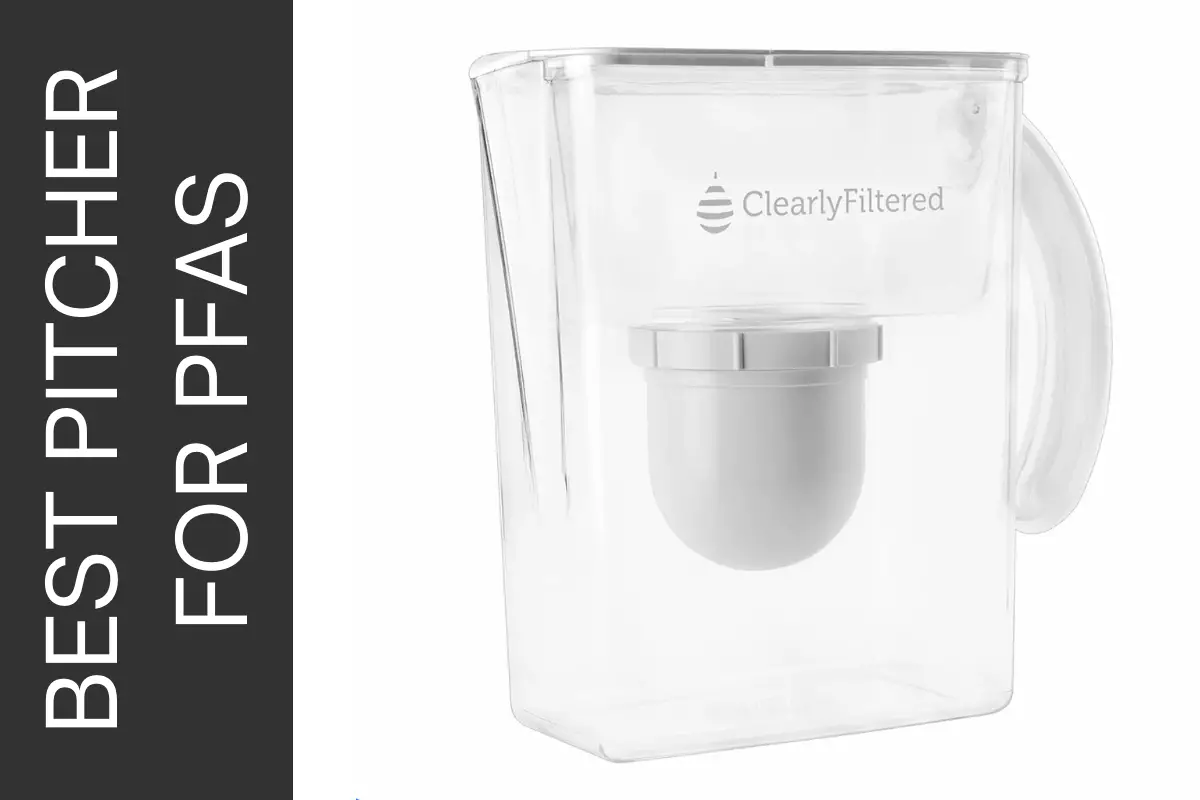
Use a certified water filter (especially one that removes PFAS — some reverse osmosis systems and specific water filter pitchers are excellent for this).
Choose PFAS-free personal care products when possible.
Avoid non-stick pans and invest in stainless steel or cast iron.
Minimize fast food and takeaway (those grease-resistant wrappers often contain PFAS).
Keep household dust down by vacuuming with a HEPA filter and damp mopping.
If you’re worried about PFAS from your daily shower or bath, you can breathe a little easier. Your skin is a great barrier, and the chances of absorbing dangerous amounts this way are very, very low. Focus your energy on what matters most: filtering your drinking water and cutting back on products that use these chemicals unnecessarily.
References:
Lin, X., Xing, Y., Chen, H., Zhou, Y., Zhang, X., Liu, P., Li, J., Lee, H.K. and Huang, Z., 2023. Characteristic and health risk of per-and polyfluoroalkyl substances from cosmetics via dermal exposure. Environmental Pollution, 338, p.122685. doi: 10.1016/j.envpol.2023.122685
Monteiro-Riviere, N.A. and Riviere, J.E., 2009. Interaction of nanomaterials with skin: aspects of absorption and biodistribution. https://doi.org/10.1080/17435390902906803
Namazkar, S., Ragnarsdottir, O., Josefsson, A., Branzell, F., Abel, S., Abdallah, M.A.E., Harrad, S. and Benskin, J.P., 2024. Characterization and dermal bioaccessibility of residual-and listed PFAS ingredients in cosmetic products. Environmental Science: Processes & Impacts, 26(2), pp.259-268. DOI: 10.1039/d3em00461a
Poothong, S., Padilla-Sánchez, J.A., Papadopoulou, E., Giovanoulis, G., Thomsen, C. and Haug, L.S., 2019. Hand wipes: a useful tool for assessing human exposure to poly-and perfluoroalkyl substances (PFASs) through hand-to-mouth and dermal contacts. Environmental science & technology, 53(4), pp.1985-1993. https://doi.org/10.1021/acs.est.8b05303
Ragnarsdóttir, O., Abdallah, M.A.E. and Harrad, S., 2022. Dermal uptake: An important pathway of human exposure to perfluoroalkyl substances?. Environmental Pollution, 307, p.119478. https://doi.org/10.1016/j.envpol.2022.119478
Tibaldi, R., ten Berge, W. and Drolet, D., 2014. Dermal absorption of chemicals: estimation by IH SkinPerm. Journal of occupational and environmental hygiene, 11(1), pp.19-31. https://doi.org/10.1080/15459624.2013.831983
Xia, C., Diamond, M.L., Peaslee, G.F., Peng, H., Blum, A., Wang, Z., Shalin, A., Whitehead, H.D., Green, M., Schwartz-Narbonne, H. and Yang, D., 2022. Per-and polyfluoroalkyl substances in North American school uniforms. Environmental Science & Technology, 56(19), pp.13845-13857. https://doi.org/10.1021/acs.est.2c02111