
Trifluoroacetic acid, or TFA, is a chemical you’ve probably never heard of but it’s showing up in more and more places, including the water you drink. It belongs to a group of chemicals known as PFAS, sometimes called “forever chemicals” because they don’t easily break down. But TFA is smaller, harder to remove, and isn’t currently regulated.
Scientists are paying more attention to TFA, and for good reason. Even though it’s not yet proven to be highly toxic, it’s turning up in rain, rivers, lakes, crops, and people. And once it’s there, it sticks around.
What Is TFA?
TFA stands for trifluoroacetic acid. It’s a small, man-made chemical that dissolves very easily in water. TFA is highly resistant to degradation in sunlight and soil under typical environmental conditions, and it doesn’t get filtered out naturally the way some other contaminants do. That means once it’s in the environment, it stays there.
TFA isn’t something most industries use directly in large quantities. Instead, it forms when other chemicals break down, especially refrigerants like HFC-134a and HFO-1234yf. These are the chemicals used in air conditioners and refrigerators. When they’re released into the atmosphere, they slowly break apart, and one of the byproducts is TFA. That TFA gets pulled down by rain and ends up in lakes, rivers, and eventually, our water supplies.
Where TFA Comes From
While refrigerants are a major source, they’re not the only one. TFA can also come from the breakdown of certain pesticides, firefighting foams, fluorinated plastics, pharmaceuticals, and even anesthetic gases used in hospitals. Once those chemicals get into the air, water, or soil, they can degrade into TFA over time.
Some of these sources are spread out across the globe. For example, HFC-134a has an atmospheric lifetime of over a decade, which means it travels far before breaking down. Others, like HFO-1234yf, break down quickly and form TFA closer to where they were released, which is usually near cities or industrial areas.
How TFA Gets into Water
Because TFA is so good at dissolving in water and doesn’t stick to soil or sediment, it moves easily through the environment. Once it’s deposited by rain or snow, it can flow into rivers, lakes, and reservoirs. And from there, it can make its way into drinking water.
A study in Northern California found that TFA levels in local streams had increased sixfold in just 23 years. The highest concentrations were found in areas directly downwind of major cities. Other research from Germany, China, and Canada shows similar increasing trends.
TFA Levels in Rainwater Around the World
TFA has been detected in rainfall, lakes, and even ice cores across many parts of the globe (e.g., Boutonnet et al., 1999; Cahill 2022; Garavagno et al., 2024), with some locations showing relatively high concentrations:
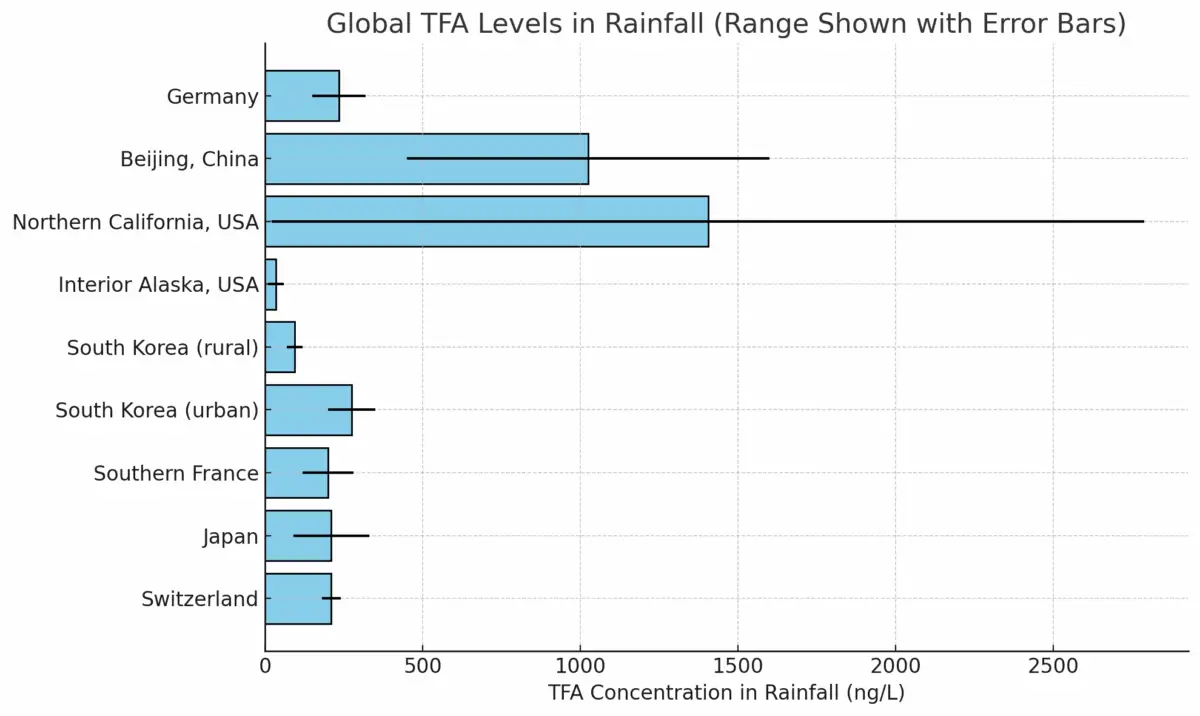
Even in remote places like Alaska and the Canadian Arctic, TFA is present-suggesting that this chemical can travel long distances before being deposited in rain or snow.
How TFA Behaves in the Environment
TFA is extremely stable. Once it’s in water, it doesn’t evaporate or break down. It’s also too small and too polar (chemically speaking) to stick to soil or be captured by most natural processes. That means it keeps moving through waterways, into groundwater, and potentially into the crops we grow and the water we drink.
Even in the air, TFA has a habit of returning (Garavagno et al., 2024). It dissolves into cloud droplets, fog, or rain and comes back to the surface.
Models of how TFA moves through the environment show that nearly all of it ends up in water (Garavagno et al., 2024).
Is TFA Dangerous?
Right now, TFA isn’t considered highly toxic. It doesn’t build up much in animal tissue, and it’s generally excreted quickly by humans, primarily by urine. But that doesn’t mean we should ignore it.
TFA has been found to affect plant growth, especially in algae and aquatic plants exposed to high levels. Some crop studies show that TFA can accumulate in plants like wheat and sunflower, though the long-term effects on food safety are still unknown.
In people, studies have found TFA in blood serum samples. One study in China detected it in more than 90% of participants. While the concentrations were low, it’s a sign that exposure is widespread. Scientists don’t yet know what the long-term health effects might be, especially with constant low-level exposure.
TFA in Plants and the Food Chain
TFA is taken up and retained in plant tissues, where it remains stable over time. Some studies have shown that TFA can be taken up by crops and accumulate in plant tissues (Garavagno et al., 2024).
So far, there’s no evidence that eating TFA-contaminated plants is harmful, but very little testing has been done. What we do know is that it doesn’t go away. It is unclear whether TFA transfers through the food chain, but its persistence in plants raises concern.
Can TFA Be Removed from Drinking Water?
Unfortunately, getting rid of TFA is very hard. Regular water treatment methods like those used at city water plants don’t work. TFA is too small and too stable to be removed by filtration, sedimentation, or chlorination.
Even methods that work on other PFAS chemicals, like activated carbon or ion exchange, aren’t effective against TFA.
The best current option is reverse osmosis, which forces water through a very tight membrane. Reverse osmosis is not widely used in public systems due to the cost, but many people have them in their homes.
Why TFA Is Difficult to Monitor
TFA is so small and soluble that it’s not easy to measure, even in labs. Unlike other PFAS chemicals, which are now routinely tested, TFA requires special equipment and preparation steps.
Most labs don’t test for it at all. Even in the U.S., where PFAS testing has become more common, TFA is not on the EPA’s list of contaminants that public utilities are required to monitor. That means it could be in your water and no one would know.
This lack of monitoring is one of the biggest challenges. Without data, it’s hard to know where TFA levels are highest or how fast they’re rising. And without that information, regulators can’t act.
Modeling the Future: What Projections Say
A model called STOCHEM-CRI has been used to estimate how different refrigerants contribute to TFA formation. It showed that newer refrigerants like HFO-1234yf and HFO-1234ze, although less harmful in terms of climate warming, produce high yields of TFA once they degrade.
Because these newer refrigerants break down faster and closer to where they’re released, TFA levels could spike in urban areas. As such, it’s likely we will see more TFA in rainwater, rivers, and potentially, drinking water supplies throughout the next few decades.
Should You Be Worried?
TFA isn’t the most dangerous contaminant out there, but it builds up, it spreads far, and we can’t remove it once it’s in our water.
If you live in an area that uses surface water for drinking, like lakes or rivers, you might want to consider using a home filtration system that includes reverse osmosis.
References:
- Boutonnet, J.C., Bingham, P., Calamari, D., Rooij, C.D., Franklin, J., Kawano, T., Libre, J.M., McCul-Loch, A., Malinverno, G., Odom, J.M. and Rusch, G.M., 1999. Environmental risk assessment of trifluoroacetic acid. Human and Ecological Risk Assessment: An International Journal, 5(1), pp.59-124.
- Cahill, T.M., 2022. Increases in trifluoroacetate concentrations in surface waters over two decades. Environmental Science & Technology, 56(13), pp.9428-9434.
- Garavagno, M.D.L.A., Holland, R., Khan, M.A.H., Orr-Ewing, A.J. and Shallcross, D.E., 2024. Trifluoroacetic acid: toxicity, sources, sinks and future prospects. Sustainability, 16(6), p.2382.