
A newly published Canadian study has revealed a potential link between dietary fiber intake and the reduction of harmful per- and polyfluoroalkyl substances (PFAS) in the human body.
These findings could open the door to simple, diet-based strategies for lowering PFAS exposure, which has become a growing public health issue due to the chemicals’ persistence and toxicity.
Often referred to as “forever chemicals,” PFAS are a class of synthetic compounds found in everyday items such as non-stick cookware, food packaging, stain-resistant fabrics, and most concerningly, drinking water.
PFAS do not break down in the environment or the human body, and their accumulation over time has been associated with liver damage, hormonal disruption, and certain cancers.
The 2025 study, led by Dr. Jennifer Schlezinger and colleagues from Boston University and the University of Massachusetts Lowell, analyzed blood samples from 72 adult men in Ontario, Canada, originally enrolled in a clinical trial to evaluate cholesterol-lowering effects of dietary fiber. As part of this four-week randomized trial, participants consumed either a control beverage or one containing oat β-glucan, which are a gel-forming, soluble fiber known for its cholesterol-reducing properties.
The researchers tested the participants’ blood for 17 PFAS compounds at the beginning and end of the trial. Every participant had measurable levels of multiple PFAS in their serum, including legacy long-chain compounds such as PFOA and PFOS, newer short-chain PFAS, and even replacement chemicals like GenX.
Most significantly, the group consuming oat β-glucan showed small but measurable reductions in long-chain PFAS levels, particularly those identified by the U.S. National Academies of Sciences (NASEM) as health risks requiring clinical follow-up. The total PFAS burden decreased in both the fiber and control groups, but only the fiber group saw significant reductions in the most concerning long-chain compounds.
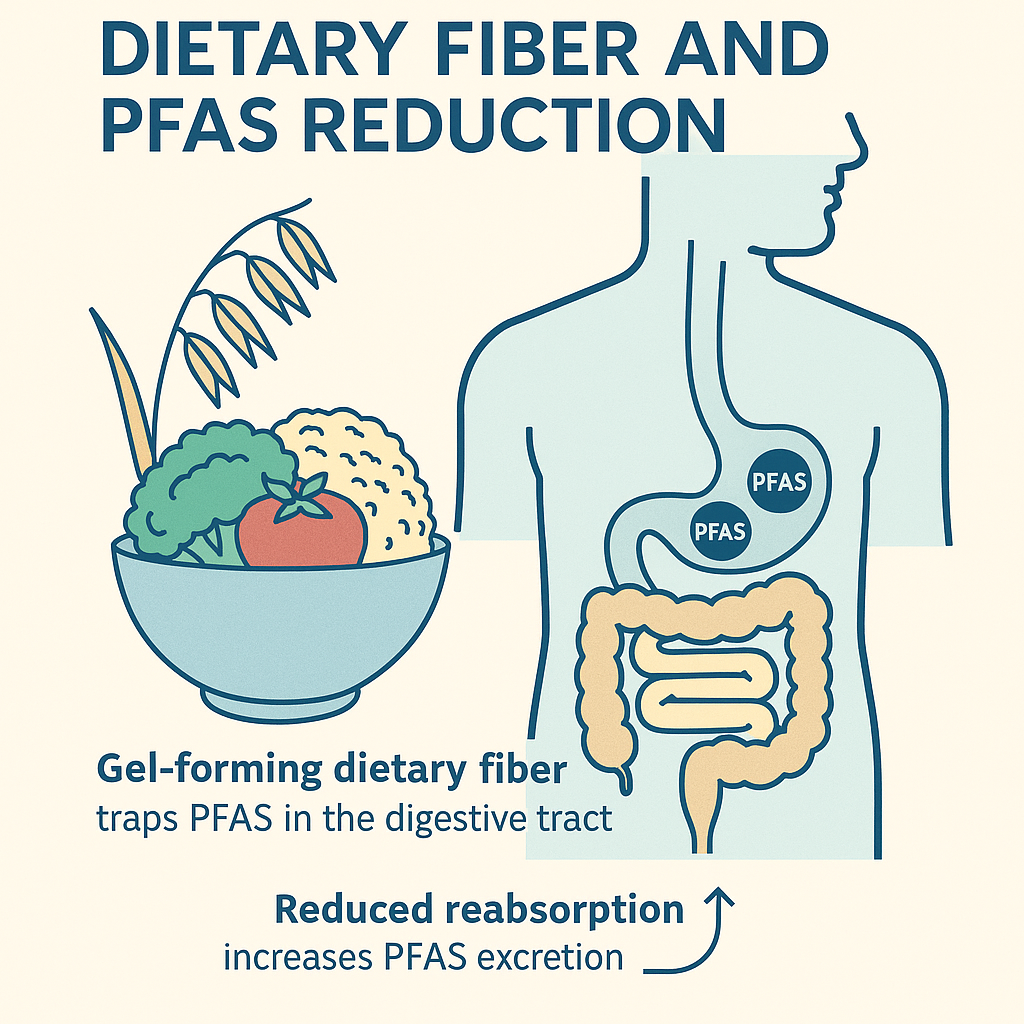
Researchers believe that fiber may interrupt the body’s enterohepatic circulation of PFAS – a biological recycling process in which chemicals excreted into the gut via bile are reabsorbed back into the bloodstream. Similar to how fiber traps bile acids (which are chemically similar to PFAS) and removes them through the digestive tract, it may also help reduce PFAS reabsorption.
While the study is not definitive, and was limited by its short duration, small sample size, and lack of exposure control, it provides an important proof of concept. The authors note that longer-term dietary interventions with higher doses of fiber could yield even stronger reductions in PFAS body burden.
As concern over PFAS in drinking water continues to grow, these findings hint at a practical, low-risk approach for reducing their impact. Incorporating more soluble dietary fiber, particularly from oats, may offer more than just cardiovascular benefits, it could help your body eliminate dangerous environmental pollutants.
Reference:
Schlezinger, J.J., Bello, A., Mangano, K.M., Biswas, K., Patel, P.P., Pennoyer, E.H., Wolever, T.M., Heiger-Bernays, W.J. and Bello, D., 2025. Per-and poly-fluoroalkyl substances (PFAS) in circulation in a Canadian population: their association with serum-liver enzyme biomarkers and piloting a novel method to reduce serum-PFAS. Environmental Health, 24(1), p.10. <https://doi.org/10.1186/s12940-025-01165-8https://doi.org/10.1186/s12940-025-01165-8>